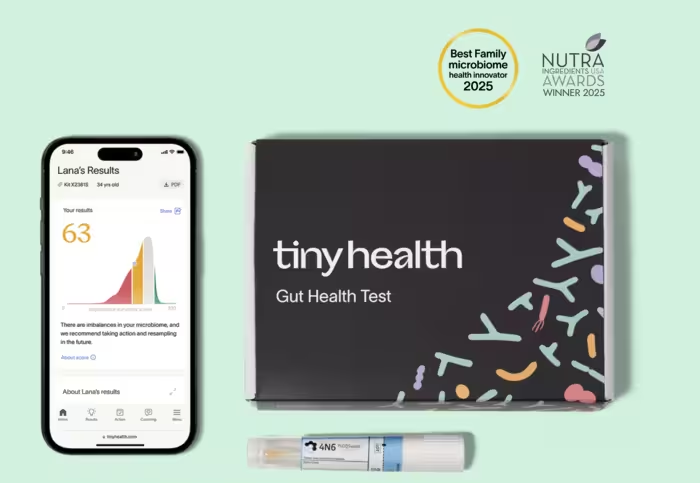
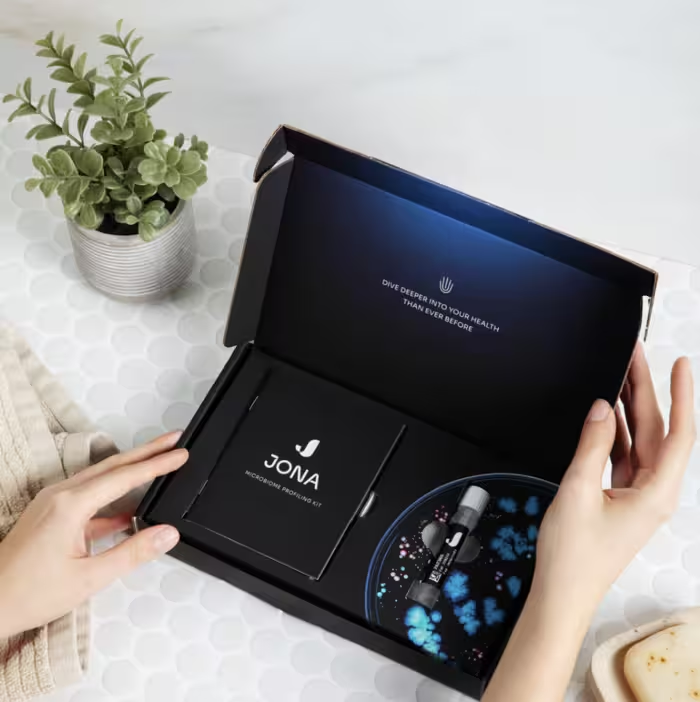
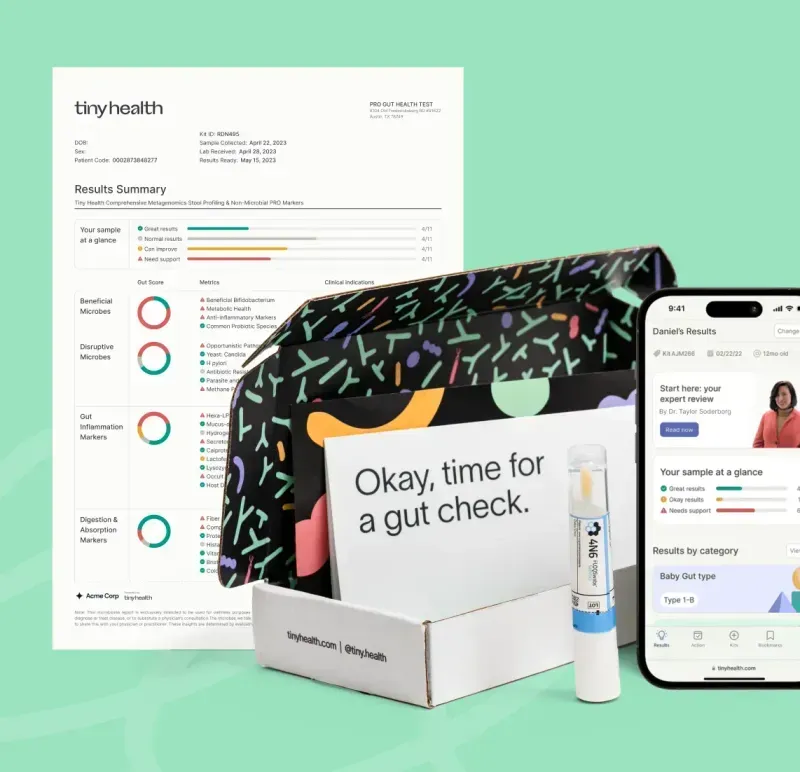
Both Tiny Health and Jona use shotgun metagenomic sequencing, the gold standard in microbiome science [1]. The sequencing is the same, but what happens after differs.
Tiny Health pairs sequencing with its own bioinformatics pipeline and a team of microbiome scientists. The team uses AI to track new research and build new metrics, then tests each one against a large internal dataset. The platform also analyzes what your microbes can do, not just which ones are present.
Jona uses an AI model trained only on published microbiome studies to link your microbiome to symptoms. There's no additional scientific interpretation and no check against a metagenomic dataset, so the accuracy of those links depends on the studies behind them. Jona also skips gene-level functional analysis and age- and stage-specific reference ranges.
Bottom line: Jona works for adults who want AI-driven condition associations from published research, with results only as reliable as the studies behind them. Tiny Health combines cutting-edge science with human expertise: scientists who track new literature, validate every finding against a large dataset, and look at what your microbes can actually do. It's also built for the full family lifespan, from pregnancy and infancy through adulthood.
You're looking at two gut microbiome tests. Both use advanced sequencing technology. Both promise personal insights. Both cost enough that it's worth knowing what sets them apart. Choosing between them isn't easy.
This article compares Tiny Health and Jona in several key areas: the technology they use, how much each test looks at, what's in the reports, pricing, and the support you get. We also look at how each company turns microbiome data into real advice, and what users can realistically expect from their results.
This comparison looks at the features of each test so you can see the strengths and limitations of each option. Whether you care about digestive health, immune function, metabolic health, or just want to learn about your microbiome, knowing these differences can help you pick the test that fits your goals.
A note on this comparison
This article includes a comparison with Jona based on publicly available information at the time of writing. Product features, pricing, and offerings may change over time. We recommend verifying details directly on the Jona and Tiny Health websites before purchasing.
How we compared Tiny Health and Jona
This comparison draws from the following sources:
Tiny Health's official website (tinyhealth.com, accessed August 18, 2026)
Jona's official website (jona.health, accessed August 18, 2026)
Peer-reviewed scientific literature
Verified user reviews from Tiny Health and Jona's websites
Evaluation criteria: Sequencing technology and resolution, microbial coverage, age-group applicability, sample collection method, quality of recommendations, pricing, turnaround time, customer support, lab certifications, and scientific validity.
Pricing was last updated on August 18, 2026, and may have changed since publication.
Tiny Health at a glance
Tiny Health was founded in 2020 by Cheryl Sew Hoy in Austin, Texas, after her own child developed eczema and food intolerances. Unable to find an infant gut test capable of identifying the root cause, she built one. Today, Tiny Health is the first precision microbiome wellness platform designed to track health across the full family lifespan — from pregnancy and the first 1,000 days of life through adulthood.
Each possible association is then checked against the company's large internal dataset of metagenomic samples. This step confirms it actually holds up before it ever appears in your report. The platform identifies microbes at the species level, and sometimes even at the strain level, using its own bioinformatics pipeline. It doesn't stop at listing which microbes are present — it also looks at what those microbes are capable of doing, like producing short-chain fatty acids (SCFAs), breaking down fiber, and keeping the gut barrier strong. Reference ranges for each metric in the test are calculated individually, so results are benchmarked for where you actually are.
Tiny Health has served more than 150,000 people and works with over 5,000 health practitioners. A published, peer-reviewed randomized controlled trial found that babies who got personalized microbiome support through the Tiny Health program had 83% lower odds of developing eczema [2].
Founded
2020
Headquarters
Austin, Texas
Test type
Shotgun metagenomic sequencing with proprietary bioinformatics pipeline
Resolution
Strain level
Sample type
Stool, also vaginal for 18+
Best for
Adults, families with babies or children, and pregnant or postpartum individuals seeking strain-level precision and functional microbiome insights for both digestive symptoms or general gut health goals.
Starting price
$249 (one-time)
Jona at a glance
Jona is a New York-based health tech company that applies artificial intelligence to gut microbiome sequencing. Founded in 2022 by Leo Grady, PhD, an AI researcher, Jona's core premise is that the hard part of microbiome testing isn't the sequencing. It's the interpretation. Their AI system indexes peer-reviewed papers and maps your microbial results against what the current literature says about conditions, symptoms, and interventions. The result is a personalized report that compares your microbiome's association to dozens of health conditions, along with food, supplement, and lifestyle recommendations pulled directly from the science.
Jona's primary audience is adults who are dealing with undiagnosed or ongoing symptoms and want a research-grounded starting point. The company has also built a version for clinicians who want to use microbiome insights in patient care.
Founded
2022
Headquarters
New York, New York
Test type
Shotgun metagenomic sequencing + AI interpretation
The sections below break down each major decision point in more depth, from what's actually happening in the lab to what you get when your results land in your inbox.
Feature
Tiny Health
Jona
Technology / sequencing method
Whole-genome shotgun metagenomics; proprietary bioinformatics pipeline and analysis platform
Scientists use AI to monitor emerging literature, then validate findings against a large internal dataset of real metagenomic samples before they reach your report
AI cross-referencing published papers of varying quality and methodology; findings delivered to your report without scientific interpretation
Resolution
Strain level; detection down to 0.005% relative abundance
Strain level
Target persona
Adults, pregnant and postpartum women, children, toddlers, and babies
Adults and children 4+
Sample collection method
Mess-free, validated dry swab for stool sampling; no spill risk
Mess-free stool sampling
Functional analysis
✓Gene-level functional analysis
✕Gene-level functional analysis is not included; some functionally relevant taxa abundances are reported
Personalized recommendations
✓Scientist-reviewed, age-specific action plan included; 30-minute group Results Review with a microbiome specialist
✓AI-generated food, supplement, and lifestyle guidance; digital twin simulates dietary impact
Age-specific reference ranges
✓Distinct ranges for babies, toddlers, children, and adults
✕No
Pricing
$249 (one-time); $399/year (Tiny+ membership, includes 2 tests)
$485 (one-time)
One-time vs. subscription
One-time purchase or Tiny+ annual membership (2 tests/year)
One-time purchase
Turnaround time
2–3 weeks
2–3 weeks
Customer support
Available via email and online support portal
Available via email
Specialist support
✓Microbiome specialist group consultation included; 1-on-1 coaching available with Tiny+ membership
✕No specialist support
Lab certifications
Lab partner is CLIA-certified and CAP-accredited
Lab partner is CLIA-certified
HSA/FSA eligibility
✓Yes
✓Yes
Clinical validation
Published RCT showing 83% reduction in infant eczema odds [2]; dedicated clinical team channels real patient outcomes from thousands of practitioners back to the science team
Described as clinically validated but no independent RCT identified at time of review
Technology & testing methodology
The sequencing method a company uses shapes everything: what organisms it can detect, the depth of insight it can offer, and whether results might change as science advances. As our guide to shotgun metagenomics vs. PCR, 16S, and RNA-Seq explains, not all microbiome tests look at the same picture.
Both Tiny Health and Jona use shotgun metagenomic sequencing — the gold standard in the field. This approach sequences all the microbial DNA in your stool sample, including from bacteria, fungi, viruses, and parasites. At the level of raw sequencing, the technology both companies use is excellent.
The two companies diverge in how they build on that sequencing data.
At Tiny Health, once your sample is sequenced, the raw sequencing data goes through a custom bioinformatics pipeline that Tiny Health built in-house. This pipeline figures out which microbes and genes are present. Because Tiny Health controls every step of this process, instead of relying on an outside tool, the system is fine-tuned to catch the microbes that matter, without falsely flagging ones that aren't really there.
Beyond just identifying microbes, Tiny Health also looks at what those microbes can do. Knowing a certain microbe is present tells you one thing. Knowing whether it can make butyrate (an SCFA that fuels your gut lining) or break down estrogen tells you something much more useful [3,4]. For a deeper look at how these approaches compare, the blog At-Home Gut Microbiome Testing: What It Measures and How It Works breaks down the science.
Tiny Health's microbiome scientists use AI to stay current with emerging research and surface new associations. From there, they validate all associations against an internal dataset of tens of thousands of microbiome samples. This allows Tiny Health to stay on the cutting edge of microbiome science while ensuring every insight and recommendation has been validated by scientists with deep expertise in the field.
Jona sends sequencing data through a third-party bioinformatics platform, then uses its own AI model to interpret the results. Jona's big selling point is scale: its AI has indexed over 600,000 papers. But a bigger library doesn't always mean a more reliable result. The AI may build associations from papers that used different methods or weaker data. Reports focus on which microbes are present and how they relate to conditions, symptoms, and diet, along with personalized food, supplement, and lifestyle suggestions based on your results. The report does not include gene-level analysis — meaning it doesn't check whether the genes needed for specific jobs, like producing butyrate, are actually present in your sample. Instead, Jona reports on how much of certain microbes are present, based on what they're known to do.
One thing worth noting: Jona's AI draws from research that uses different sequencing methods, including 16S sequencing studies, which identify microbes differently than shotgun metagenomics does. Associations built from these different data types aren't always comparable to each other. And since there's no scientific team checking whether an association is actually meaningful before it reaches your report, the quality of your results depends heavily on the quality and consistency of the studies the AI was trained on. Tiny Health's process works the other way around: nothing reaches your report until it's been checked against real-world data first.
Feature
Tiny Health
Jona
Method
Shotgun metagenomic sequencing
Shotgun metagenomic sequencing
Analysis platform
Proprietary bioinformatics pipeline
Third-party technology partner
Interpretation
Scientists use AI to monitor emerging literature and develop new computational metrics, then validate whether findings hold in a large internal dataset of real metagenomic samples
AI cross-referencing published papers of varying quality and methodology; findings delivered to your report without scientific interpretation
What it detects
Bacteria, fungi, viruses, parasites, archaea
Bacteria, fungi, viruses, parasites, archaea
Resolution
Strain level; detection down to 0.005% relative abundance
Strain level; minimum abundance not reported
Functional analysis
Yes, functional potential for SCFA production, fiber digestion, gut barrier, toxin genes, and more
Gene-level functional analysis is not included, some functionally relevant taxa abundances are reported
Limitations
Sequencing takes longer than targeted tests like qPCR
AI associations influenced by training data quality
Microbiome coverage & functions analyzed
What a test measures determines what you can actually do with the results. Here's how Jona and Tiny Health stack up in terms of coverage.
What’s analyzed
Tiny Health
Jona
Bacterial species
Yes
Yes
Strain-level identification
Yes
Yes
Fungi
Yes
Yes
Viruses
Yes
Yes
Archaea
Yes
Yes
Functional pathways
Yes — functional potential for SCFA production, fiber digestion, gut barrier markers, urolithin-A potential, GLP-1 production, beta-glucuronidase, and more
Abundance of functionally relevant taxa is reported; gene-level pathway analysis is not included
Metabolites
Yes, metabolite production potential via functional data
Metabolite-producing taxa abundance only
Pathogen flags
Yes
Yes
Dysbiosis flags
Yes (via overabundant disruptive and depleted beneficial microbes)
Yes (via condition associations)
Antibiotic resistance genes
Antibiotic resistance signature available
No
Beneficial bacteria
Yes
Yes
Gut microbiome diversity
Yes
Yes
Health-related interpretation
Yes, age-specific conditions associations, personalized action plan, and a specialist interpretation group call
Yes, AI-generated associations to 30+ conditions and food, supplement, lifestyle guidance
Which test is the best fit by age group and why
One of Tiny Health's most practical advantages is that its reference ranges aren't one-size-fits-all. Every result is benchmarked against an age-specific dataset — babies against babies, adults against adults — built from internally collected samples using consistent methods. That means babies get the same careful calibration adults do, not a comparison to whoever happened to be in a published study. Use the table below to see where each test fits your situation.
If you are…
Tiny Health fit
Jona fit
A parent testing a baby
Yes, the only clinically validated gut test for babies
Not designed for use in babies
A parent testing a toddler or child
Yes, age-specific ranges and recommendations for toddlers and children
Maybe; not available under the age of 4
Pregnant or postpartum
Yes, gut and vaginal tests (18+) available with pregnancy-specific reference ranges
While available, reference ranges are not designed for these populations
An adult with general gut health concerns
Yes, comprehensive adult test with personalized action plan
Yes, condition associations and food guidance tailored to results
An adult with GI symptoms
Yes, condition associations, functional insights, and a specialist group consultation to help you interpret findings
Yes, AI highlights associations between your microbiome and conditions like bloating, IBS, acid reflux
Recovering after antibiotics
Yes
Yes
A biohacker looking for advanced microbiome data
Yes, condition associations developed through AI-powered computational methods; functional data and longitudinal testing
Yes, digital twin simulation and AI condition mapping
Looking for practitioner-backed interpretation
Yes, 5,000+ practitioners use Tiny Health; optional stool chemistry add-on available
Yes, practitioner program available with optional stool chemistry add-on
Looking for a one-time gut health snapshot
Yes ($249 one-time)
Yes ($485 one-time)
Looking for ongoing microbiome tracking
Yes, Tiny+ membership offers 2 tests/year with continued one-on-one coaching access
Yes, recommended retest every 3–6 months
Sample collection and user experience
Getting the sample from your bathroom to the lab is when many people first hesitate about microbiome testing. Both companies try to minimize friction in this process.
Tiny Health uses a validated, dry swab collection method [5] — no liquid buffer, no spill risk. You touch the swab to used toilet paper, so no handling of stool is required. The swab uses a drying agent (called desiccant) to keep microbial material stable at room temperature. This means you can mail the sample whenever it's convenient, ideally within five days of collecting it. Helpful demonstrations are available on the Tiny Health website. Results typically arrive within 2-3 weeks.
Jona ships the next day and describes its collection process as a "mess-free stool sample collection." Based on their product page, everything needed for a clean process is included in the kit. After collection, you ship the sample to their CLIA-certified laboratory. Results arrive within 2-3 weeks.
Pricing, turnaround time, and customer support
Microbiome testing is a meaningful investment. Here's what you're getting for your money with each option.
Both, one-time or Tiny+ annual membership (2 tests/year)
One-time purchase
Retest discount
Yes, Tiny+ Membership retesting discount
No discount available
HSA / FSA eligibility
Yes
Yes
What’s included
At-home test kit, personalized report, age-specific action plan, 30-minute Group Results Review with a microbiome specialist
At-home test kit, AI-powered personalized report, condition associations, food and lifestyle recommendations linked to studies
Sample collection kit included
Yes
Yes
Shipping included
Yes (free)
Yes (free, next-day shipping)
Turnaround time
2–3 weeks
2–3 weeks
Results dashboard included
Yes
Yes
Personalized action plan included
Yes
Yes
Customer support channels
Email, online support portal (support.tinyhealth.com)
Email
Refund / replacement policy
Partial refund (minus 3% fee) before fulfillment; partial refund (minus $34/kit) within 14 days; no refunds after 14 days
Full refund before fulfillment; partial refund (minus $55) within 14 days if kit hasn’t reached the lab; no refunds after 14 days
Pricing last checked
August 18, 2026
August 18, 2026
Personalized recommendations: How actionable are the insights?
Sequencing data is only useful if it tells you what to do. How each platform turns raw results into guidance is where the two approaches diverge most clearly.
Tiny Health's recommendations are built by microbiome scientists, based on published research, and matched to your age and your own test results, not copied from a generic template. Tiny Health doesn't earn commissions from supplements or probiotics, so any product suggestion is based only on your data, not on what earns the company money.
Every test includes a 30-minute Group Results Review, where you talk with a microbiome specialist, ask questions, and build your action plan together in real time. Tiny+ members also get ongoing one-on-one coaching, and you can bring your own doctor or practitioner into the process through PoweredbyTiny.com. Tiny Health checks its insights against its own research data, and scientists use AI to keep up-to-date with current scientific findings, updating metrics regularly as new evidence comes out. For parents, Tiny Health offers age-specific action plans made for babies, filling a gap that most adult-focused tools can't. Jona doesn't offer anything like this for interpreting a baby's microbiome results.
Jona generates an AI-driven report that maps your microbial profile against published literature to surface associations with conditions, symptoms, and potential food triggers. For each finding, the report indicates strength of evidence and suggests specific foods, probiotics, or lifestyle practices. Jona's digital twin layer simulates how dietary changes might shift your microbial balance before you commit to them. Reports also update automatically as new research is published — you might log in months later and find your associations have changed based on new science. Jona also states they have no supplement affiliate relationships.
Jona's reports don't include gene-level functional data. You'll learn which organisms are present, which functions they're known to perform, and which conditions the literature associates with your profile — but not whether the underlying genes required for those functions are actually present in your sample. The recommendations you do receive are generated entirely by AI, so their reliability is only as good as the research behind them, with no scientific team weighing in on whether a given finding is strong enough to act on.
Verified reviews: What people are saying about Jona and Tiny Health
Brad W.: "I've been getting into gut health over the last couple years and have even taken other test kits. Tiny Health definitely is leading the space with their knowledge and reporting. I haven't even done the consult yet, which I'm looking forward to. Great work!"
Jessica M.: "Initially we were simply interested in the microbiome of our baby, and he turned out to have low levels of bifidobacteria. We found that a few days of a recommended probiotic already solved that problem! Then things got more serious. At 6 months old he was hospitalized with severe pneumonia, and needed the most extreme antibiotics to save his life. It took a while but after months of following Tiny Health's advice, no trace of potentially antibiotic-resistant bacteria are left!"
Mary: "100% Recommended. Results are easy to understand and there is a lot of useful information regarding gut health and overall health as well. Love how results are presented and how easily you can have a consultation call in case you want more information."
Rich Maurer: "My grandson and I both took the same strain of B. infantis and we were the first consumers to have this strain detected in our Tiny Health gut test. No other testing company was able to detect this beneficial strain, which completely turned around my grandson's gut from extremely inflammatory to anti-inflammatory. It also reestablished a healthy amount of bifidobacteria in my gut. Thanks, Tiny Health"
Jason: "This is the second biome test I’ve done. One with Jona and one with another brand. Jona was far more expensive (almost double) and I feel like the experience was not worth it."
Michelle: "My Jona report told me that I couldn't digest gluten or lactose and that I had an association to IBS along with lots of advice to help the condition. With the help of the dietitian, I started following the report suggestions and within a few weeks everything changed, I no longer had any problems with constipation."
Jen: “I was excited to do this and I went thru the process which isn’t the most pleasant (not Jona’s issue- just not fun collecting your own sample). Anyway, once I was ready to mail in, you have to register before you do and their site doesn’t work. I tried on all my Mac devices and cleared cache and it just comes up blank. Not cheap and not a good experience.”
Which test is better for you?
Choose Tiny Health if…
You're an adult who wants the most rigorous, functionally-grounded microbiome test available
You're testing a baby, toddler, or child and need age-appropriate reference ranges
You're pregnant, postpartum, or want a vaginal microbiome test (18+) alongside your gut test
You want a group specialist consultation included with your results
You're looking for a more affordable entry point into whole-genome sequencing ($249 vs. $485)
You prefer insights developed with AI but interpreted and validated by microbiome experts and clinicians with real-life patient experience, not just AI-verified data
You want to track your microbiome across time with a Tiny+ membership that includes retesting
You're working with a functional medicine practitioner or integrative clinician who uses the Powered by Tiny platform
You want to see how your microbiome connects to health conditions
Choose Jona if…
You're an adult dealing with persistent, undiagnosed symptoms and want an AI-generated map of how your microbiome's composition might connect to those conditions — keeping in mind that those associations depend on the quality of the research behind them
You're drawn to a digital twin AI simulation that models how specific dietary changes might shift your gut microbiome before you commit to them
Consider both if…
You're a health-focused adult who wants to learn about their gut microbiome through the most sensitive sequencing technique
You've already tested with one platform and want a second data point using a different recommendation methodology before making significant lifestyle changes
You want a report that updates as new research is published, without needing to retest
You want strain-level identification, which enables more precise probiotic and supplement recommendations than species-level analysis allows
Why Tiny Health stands out
What makes Tiny Health worth the investment is less about any single feature and more about how these strengths fit together. The team is made up of real scientists and clinicians, people who use AI to stay up to date with current literature, verify what the data is actually saying, and hear directly from customers every day about how the test is affecting their health. From parents of newborns to adults dealing with hormonal and digestive issues to those recovering from antibiotic use, Tiny Health’s reports deliver advanced, science-backed insights and a personalized Action Plan. Plus, if you’re tracking your microbiome progress over time, a Tiny+ Membership is a more affordable option. The result is a test that doesn't just tell you what's in your gut, it's the one backed by published proof that acting on the results actually works.
Disclaimer: Tiny Health tests are processed at a CLIA-certified, CAP-accredited laboratory and are intended to educate you about the microbes in your body for wellness purposes. Tiny Health tests are not intended to diagnose or treat disease, and are not a substitute for professional medical advice.
Trust your gut.
Get to know your microbes with an easy, 5-minute at-home test from Tiny Health. Unlock deep gut health insights and personalized recommendations for your diet, supplements, and lifestyle.
Dr. Hannah Sturgeon, a Neuroscience Ph.D. from Georgia State University, specializes in microbiome research with expertise in early gut-brain-immune development.
[1] C. Quince, A. W. Walker, J. T. Simpson, N. J. Loman, and N. Segata, "Shotgun metagenomics, from sampling to analysis," Nature Biotechnology, vol. 35, no. 9, pp. 833–844, 2017, doi: 10.1038/nbt.3935.
.avif)