Gut dysbiosis is a shift in your gut microbiome affecting digestion, energy, and mood. Triggers include antibiotics, stress, poor sleep, and limited dietary variety. Testing options range from breath tests to at-home stool microbiome tests. Support recovery with fiber-rich foods, fermented foods, and consistent lifestyle habits. A gut health test can move you from guesswork to personalized next steps.
Gut Dysbiosis: Signs It's Time to Test and How to Support Recovery

Summary
Your gut is home to trillions of microbes, from bacteria to fungi, that influence how you digest food, fight infections, and feel on a given day [1]-[3]. When this community shifts out of balance, a state researchers often call gut microbiota dysbiosis, your body may not immediately connect it to digestion.
Gut dysbiosis is not a formal diagnosis, but it can help explain recurring digestive symptoms, post-antibiotic changes, or that persistent feeling that something is off [4]. Understanding the signs, when to consider a gut dysbiosis test, and how to support gut recovery can point you toward a clearer next step.
Gut dysbiosis, simply explained
Before exploring what can go wrong, it helps to understand a few key terms.
- Gut microbiome: The community of microorganisms living in your digestive tract, including their genes and the environment they create. It influences digestion, immunity, and mental well-being [1].
- Gut dysbiosis: A state where the community has shifted, often meaning fewer beneficial bacteria, less microbial diversity, or an overgrowth of unfriendly organisms [4].
- Microbial diversity: The variety of species in your gut. Higher diversity is generally associated with a more resilient microbiome [5], [6].
- Microbial balance: The relative proportions of different organisms. A healthy balance doesn't require one perfect ratio. It means the overall mix supports your body's needs [7].
Dysbiosis isn't limited to the gut. Imbalances can also occur in the mouth, on the skin , or in the vaginal microbiome [8]-[10]. This post focuses on the gut, where the effects tend to ripple widest. When microbial balance tips (what researchers call gut microbiome dysbiosis), digestive symptoms and other issues can follow [4].
What can throw your gut out of balance?
Gut imbalance rarely happens overnight. It usually builds through everyday patterns you wouldn't immediately connect to digestion. The most common gut dysbiosis causes often involve repeated disruptions to your microbiome, including antibiotics, ultra-processed diets, poor sleep, and ongoing stress.
Common Triggers of Gut Imbalance
| Pattern or trigger | How it may show up |
|---|---|
| Antibiotics | Digestive discomfort or irregularity during microbiome recovery [11] |
| Low-fiber, highly processed eating patterns | Reduced microbial resilience and stability [12] |
| Ongoing stress | Greater gut sensitivity and discomfort [13] |
| Poor or irregular sleep | Harder recovery and less stable gut patterns [14]-[15] |
| Frequent alcohol consumption | Shifts in microbial balance and increased inflammation [16] |
| Limited dietary variety | Lower microbial diversity over time [17] |

Many of these triggers overlap. Stress can disrupt sleep, which may influence food choices, which then affects your microbiome.
When it's time to look deeper
Sometimes diet and lifestyle adjustments are enough to help rebalance your gut. Other times, symptoms persist despite your best efforts. That may be a sign it’s worth taking a closer look.
Consider a gut health test if:
- Digestive symptoms keep returning even after dietary changes
- Your digestion has felt different since taking antibiotics
- You’re experiencing a mix of symptoms across digestion, mood, skin, and energy
- You’re making consistent lifestyle changes, but not noticing much improvement
- Constipation, diarrhea, or both keep coming back
- Your stool has changed noticeably in texture, color, or smell for an extended period
- You feel like your digestion has been off for a while, even if it’s hard to pinpoint why
None of these alone confirms dysbiosis of the gut, and symptoms can mimic other conditions. But when several show up together or persist over weeks, a gut health test may help clarify what's going on.
Gut dysbiosis test: what your options can and cannot tell you
There’s no single gut dysbiosis test that gives you a simple yes-or-no answer. Different testing approaches look at different parts of gut health, from microbial balance to digestion, metabolism, or motility. The most helpful approach often combines symptom history, lifestyle patterns, and testing when appropriate.
Gut Health Testing Options: Benefits and Limitations
| Testing option | What it may help with | What it cannot do alone |
|---|---|---|
| Symptom and food tracking | Spot patterns and triggers | Measure the microbiome |
| Standard clinical GI workup | Rule out digestive conditions | Assess microbiome balance |
| Hydrogen breath test | Detect possible SIBO | Assess overall gut diversity |
| Urine organic acid testing (OAT) | Identify metabolic byproducts | Profile the microbiome |
| DIY transit-time testing | Estimate gut motility | Explain root causes |
| At-home stool microbiome testing | Reveal microbial patterns and diversity | Diagnose every symptom |
| Follow-up testing over time | Track microbiome shifts | Capture the full picture |
A stool microbiome test, especially one using shotgun metagenomic sequencing, offers the most detailed view. It can highlight low diversity, flag disruptive organisms, and show whether you have enough beneficial bacteria. (This differs from PCR-based panels like GI Mapping, which screen for a predetermined list of organisms rather than mapping the full diversity of your gut ecosystem.) You collect a small sample at home, mail it to a lab, and receive a report with your diversity breakdown and next steps.
Results are most useful when paired with your own observations about diet and habits. A gut health test is one important lens, not the entire picture.
Gut dysbiosis after antibiotics: why it happens
Antibiotics eliminate bacteria without distinguishing between harmful organisms and the beneficial microbes your gut relies on. This is why antibiotics and gut health are so closely linked.
Your microbiome is resilient, but gut recovery after disruption may take weeks to months, depending on your biology and triggers [18]. Certain beneficial microbes may not fully return on their own [19]. While your gut is recovering, microbial balance can remain a little more fragile.
Understanding this impact helps you plan ahead. If your digestion shifted after antibiotics and hasn't normalized, that's a meaningful clue worth exploring with testing.
How to support recovery from gut dysbiosis
If you're wondering how to fix gut dysbiosis, start by creating the right conditions for your microbiome to rebuild.
Practical Tips to Rebalance Your Gut
| Recovery support | Why it helps |
|---|---|
| Eat more fiber-rich foods and whole foods | Supports beneficial microbes and diversity |
| Reduce ultra-processed foods | Supports a healthier microbial balance [12] |
| Improve sleep and manage stress | Supports gut-brain axis and microbiome stability [20], [21] |
| Use probiotics selectively | Supports recovery in specific situations [22] |
| Review medications and health history | Helps identify likely drivers of imbalance |
| Stay consistent over time | Sticking to daily habits helps recovery |
Probiotics can be helpful in some situations, but not every strain works the same way. A 2018 study published in Cell found that some standard probiotic supplements temporarily delayed natural microbiome recovery after antibiotics [23]. Specific strains can either help or hinder recovery, so choosing strains guided by your microbiome data is more targeted than a generic supplement.
Gut recovery looks different for everyone, which is why personalized gut insights based on microbiome data can be so valuable.
A gut dysbiosis diet: what to focus on
A few dietary principles go a long way:
- Prioritize plant diversity. Aim for a wide range of vegetables, fruits, legumes, nuts, and seeds each week. Variety matters more than volume.
- Include prebiotic-rich foods. Certain fibers, like inulin (in garlic, onions, and asparagus), resistant starch (in cooked-and-cooled potatoes), and FOS (in bananas and leeks), selectively nourish beneficial gut bacteria.
- Add fermented foods regularly. Yogurt, kefir, sauerkraut, kimchi, and miso introduce live cultures that support microbial balance.
- Choose whole grains over refined ones. Whole grains deliver the fiber your beneficial bacteria need.
- Cut back on ultra-processed foods. Packaged snacks, sugary drinks, and heavily processed meals work against a balanced gut.
- Stay hydrated. Water supports your intestinal lining and helps maintain a hospitable environment for beneficial microbes.
A gut dysbiosis diet doesn't need to be restrictive. For those exploring how to support gut health naturally, small and consistent shifts in what you eat can meaningfully influence your microbial diversity and balance over time.
The gut health big picture
If your gut doesn’t feel right, the most helpful next step is often to look at the broader microbiome picture rather than guessing from symptoms alone.
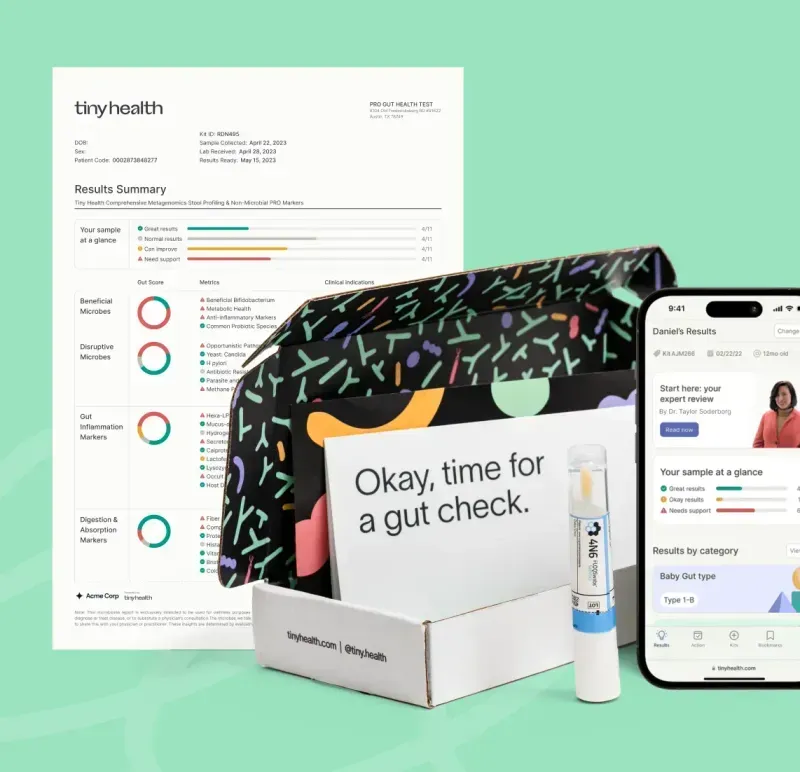
A Gut Health Test can give you clearer insight into microbial balance, diversity, and gut patterns. Your personalized Action Plan will help you focus on changes that support a balanced gut to help you feel your best.
Trust your gut.
Get to know your microbes with an easy, 5-minute at-home test from Tiny Health. Unlock deep gut health insights and personalized recommendations for your diet, supplements, and lifestyle.

Dr. Harold Nunez, a Medical Technologist and Ph.D. holder, specializes in microbiome research with over 10 years of experience.

References
[1] K. Hou et al., “Microbiota in health and diseases,” Sig Transduct Target Ther, vol. 7, no. 1, p. 135, Apr. 2022, doi: 10.1038/s41392-022-00974-4.
[2] D. Zheng, T. Liwinski, and E. Elinav, “Interaction between microbiota and immunity in health and disease,” Cell Res, vol. 30, no. 6, pp. 492–506, Jun. 2020, doi: 10.1038/s41422-020-0332-7.
[3] J. F. Cryan et al., “The Microbiota-Gut-Brain Axis,” Physiol Rev, vol. 99, no. 4, pp. 1877–2013, Oct. 2019, doi: 10.1152/physrev.00018.2018.
[4] S. E. Winter and A. J. Bäumler, “Gut dysbiosis: Ecological causes and causative effects on human disease,” Proceedings of the National Academy of Sciences, vol. 120, no. 50, p. e2316579120, Dec. 2023, doi: 10.1073/pnas.2316579120.
[5] E. Rosenberg, “Diversity of bacteria within the human gut and its contribution to the functional unity of holobionts,” npj Biofilms Microbiomes, vol. 10, no. 1, p. 134, Nov. 2024, doi: 10.1038/s41522-024-00580-y.
[6] O. Perzon and Y. Ilan, “Understanding gut microbial diversity using systems based on the Constrained-Disorder Principle provides a novel approach to targeting gut microbiome therapies,” Front. Microbiol., vol. 16, Dec. 2025, doi: 10.3389/fmicb.2025.1713775.
[7] M. V. Hul, P. D. Cani, C. Petitfils, W. M. D. Vos, H. Tilg, and E. M. El-Omar, “What defines a healthy gut microbiome?,” Gut, vol. 73, no. 11, pp. 1893–1908, Nov. 2024, doi: 10.1136/gutjnl-2024-333378.
[8] F. M. Georges, N. T. Do, and D. Seleem, “Oral dysbiosis and systemic diseases,” Front. Dent. Med., vol. 3, Sep. 2022, doi: 10.3389/fdmed.2022.995423.
[9] A. Borrego-Ruiz and J. J. Borrego, “Microbial Dysbiosis in the Skin Microbiome and Its Psychological Consequences,” Microorganisms, vol. 12, no. 9, p. 1908, Sep. 2024, doi: 10.3390/microorganisms12091908.
[10] Y. Han, Z. Liu, and T. Chen, “Role of Vaginal Microbiota Dysbiosis in Gynecological Diseases and the Potential Interventions,” Front. Microbiol., vol. 12, Jun. 2021, doi: 10.3389/fmicb.2021.643422.
[11] J. Ramirez, F. Guarner, L. Bustos Fernandez, A. Maruy, V. L. Sdepanian, and H. Cohen, “Antibiotics as Major Disruptors of Gut Microbiota,” Front. Cell. Infect. Microbiol., vol. 10, Nov. 2020, doi: 10.3389/fcimb.2020.572912.
[12] D. Rondinella et al., “The Detrimental Impact of Ultra-Processed Foods on the Human Gut Microbiome and Gut Barrier,” Nutrients, vol. 17, no. 5, p. 859, Jan. 2025, doi: 10.3390/nu17050859.
[13] A. A. Madison and M. T. Bailey, “Stressed to the Core: Inflammation and Intestinal Permeability Link Stress-Related Gut Microbiota Shifts to Mental Health Outcomes,” Biol Psychiatry, vol. 95, no. 4, pp. 339–347, Feb. 2024, doi: 10.1016/j.biopsych.2023.10.014.
[14] E. A. Holzhausen et al., “Associations of gut microbiome richness and diversity with objective and subjective sleep measures in a population sample,” Sleep, vol. 47, no. 3, p. zsad300, Mar. 2024, doi: 10.1093/sleep/zsad300.
[15] R. P. Smith et al., “Gut microbiome diversity is associated with sleep physiology in humans,” PLOS ONE, vol. 14, no. 10, p. e0222394, Oct. 2019, doi: 10.1371/journal.pone.0222394.
[16] G. Chen et al., “Gut microbiota dysbiosis: The potential mechanisms by which alcohol disrupts gut and brain functions,” Front. Microbiol., vol. 13, Jul. 2022, doi: 10.3389/fmicb.2022.916765.
[17] T. Segev et al., “Diet–microbiome associations in 10,068 individuals from the Human Phenotype Project to guide personalized nutrition,” Nat Med, vol. 32, no. 5, pp. 1884–1894, May 2026, doi: 10.1038/s41591-026-04312-x.
[18] A. Safarchi, G. Al-Qadami, C. D. Tran, and M. Conlon, “Understanding dysbiosis and resilience in the human gut microbiome: biomarkers, interventions, and challenges,” Front. Microbiol., vol. 16, Mar. 2025, doi: 10.3389/fmicb.2025.1559521
[19] A. Palleja et al., “Recovery of gut microbiota of healthy adults following antibiotic exposure,” Nat Microbiol, vol. 3, no. 11, pp. 1255–1265, Nov. 2018, doi: 10.1038/s41564-018-0257-9.
[20] A. Zarrinpar et al., “Antibiotic-induced microbiome depletion alters metabolic homeostasis by affecting gut signaling and colonic metabolism,” Nat Commun, vol. 9, no. 1, p. 2872, Jul. 2018, doi: 10.1038/s41467-018-05336-9.
[21] J. A. Foster, L. Rinaman, and J. F. Cryan, “Stress & the gut-brain axis: Regulation by the microbiome,” Neurobiology of Stress, vol. 7, pp. 124–136, Dec. 2017, doi: 10.1016/j.ynstr.2017.03.001.
[22] B. Sarita, D. B. Samadhan, M. Z. Hassan, and E. G. Kovaleva, “A comprehensive review of probiotics and human health-current prospective and applications,” Front. Microbiol., vol. 15, Jan. 2025, doi: 10.3389/fmicb.2024.1487641.
[23] J. Suez et al., “Post-Antibiotic Gut Mucosal Microbiome Reconstitution Is Impaired by Probiotics and Improved by Autologous FMT,” Cell, vol. 174, no. 6, pp. 1406-1423.e16, Sep. 2018, doi: 10.1016/j.cell.2018.08.047.
Related posts

Get $10 OFF to kickstart your microbiome health journey