Your gut and your heart sit about a foot apart, but they’re in near-constant contact. Your gut microbiome, the trillions of microbes living in your digestive tract, makes compounds that travel through your blood and may affect your blood pressure, cholesterol, and inflammation in your blood vessels. Researchers call this link the gut-heart axis.
Below, we cover how the gut and heart communicate, what research shows about gut bacteria and heart disease, how to tell gut symptoms from heart symptoms, and the daily habits linked to better health for both. If you’ve taken a Tiny Health test, you can see how this axis plays out in Gut-Body Connections, the interactive feature in your report that links patterns in your gut microbiome to different body systems.
Gut and heart connection explained
The gut-heart connection is the way your digestive system and your cardiovascular system (your heart and blood vessels) affect each other. The microbes in your gut are part of this. Several pathways link the two, and they run both ways:
Gut to heart: Gut microbes break down food into compounds that enter your blood. Some of these compounds are linked to how flexible your blood vessels stay, how your body handles cholesterol, and how it controls blood pressure [1].
Heart to gut: When the heart pumps less well, as in heart failure, less blood flows to the intestines [2]. This is linked to a thicker, leakier gut wall and more bacteria stuck to the gut lining [3].
Shared signals: Inflammation and nerve signals pass between the two systems. So a problem in one can echo in the other.
How the cardiovascular and digestive systems work together
Before we get to microbes, it helps to see how much the cardiovascular system and digestive system rely on each other every day:
Blood supply: Your heart pumps oxygen-rich blood to your stomach and intestines. At rest, they get a large share of your blood flow.
Nutrient delivery: Nutrients from your gut go to your liver first. Then your blood carries them to the rest of your body.
After meals: More blood flows to your gut after you eat, as your digestive system gets to work [4].
Fat and cholesterol handling: Your gut absorbs fats from food. Your liver uses cholesterol to make bile acids, which help digest fat. Your gut then takes most of that bile back up and returns it to the liver [5]. This cycle controls blood cholesterol levels, preventing buildup that clogs arteries.
A protective barrier: Your gut lining helps keep bacteria and their fragments out of your blood. This keeps your immune system, and your blood vessels, from staying on constant alert [1].
Shared wiring: The vagus nerve and the autonomic nervous system (the nerves that run your body on autopilot) link both organs to your brain. Together, they adjust your heart rate and digestion.
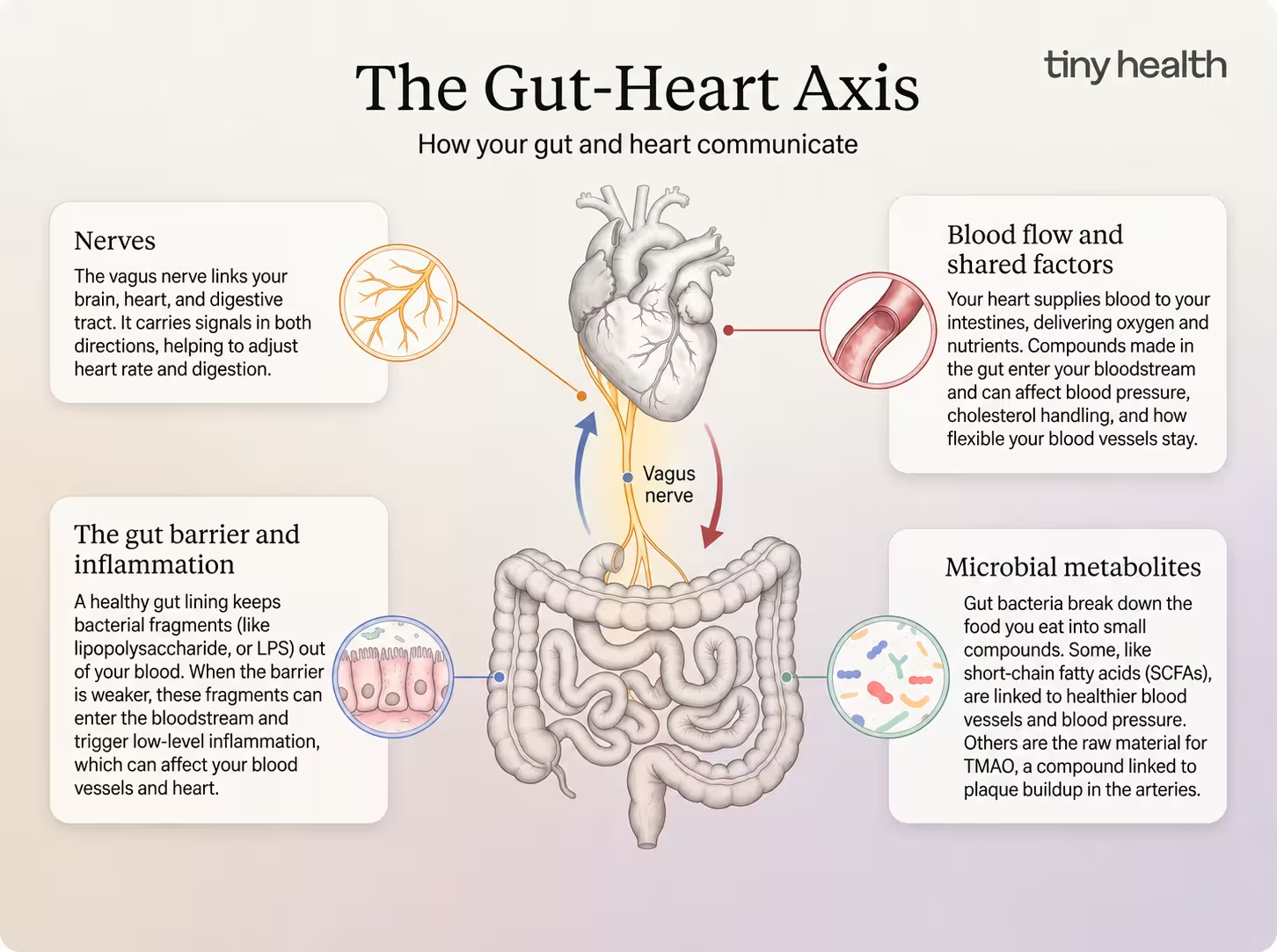
Gut-Heart axis diagram: How your gut and heart communicate
These pathways feed into each other, so researchers study the gut-heart axis as one system.
The gut-heart axis, also called the heart gut axis, is the network your gut and heart use to influence each other through four main lines of communication.
1. Nerves. The vagus nerve runs from your brainstem, through your chest, and into your belly. Along the way, it reaches both your heart and your digestive tract. Many of its fibers carry signals from your organs up to your brain. Your brain then helps adjust your heart rate and digestion [6]. For example, when the stomach wall stretches, “fight or flight” nerve activity and blood pressure go up in healthy young adults [7].
2. Microbial metabolites. Gut bacteria turn the food you eat into many small compounds, called metabolites. Some, like short-chain fatty acids, are linked to healthier blood vessels and blood pressure. Others are the raw material for TMAO, a compound linked to plaque buildup [1].
3. The gut barrier and inflammation. A healthy gut lining keeps bacterial fragments out of your blood. One of these fragments is called lipopolysaccharide (LPS). When the barrier is weaker, a state often called “leaky gut,” these fragments can get into your blood. There, they can trigger low-level inflammation, which plays a key role in many forms of cardiovascular disease [1].
4. Blood flow. Your gut needs a steady blood supply. When the heart struggles, the gut gets less blood [2]. The gut lining may then become leakier, which may add to inflammation [3].
These channels feed into each other. That’s why researchers now see the gut microbiota in cardiovascular health and disease as a system, not a single pathway.
Gut bacteria and heart disease: what the research shows
Research on gut bacteria and heart disease has grown fast since the first TMAO studies about 15 years ago [1], [8]. Most of this research is observational. That means it shows links, but it can’t prove that one thing leads to another. Other studies are done in animals. Human trials that test whether changing the microbiome changes heart health are still new [1]. Here are the pathways scientists have studied most.
TMAO and plaque buildup (atherosclerosis)
When you eat red meat, egg yolks, or some dairy, certain gut bacteria turn nutrients in those foods into a compound called TMA. Your liver then turns TMA into TMAO [1].
TMAO has been linked to plaque buildup in the arteries, a process called atherosclerosis [8]. People with higher TMAO levels tend to have a higher risk of heart attack and stroke [9], [10], [11].
What you eat can change your TMAO levels. Eating more red meat raises them, and cutting back brings them down again [12]. Scientists are still working out how much TMAO itself drives heart disease [1].
Short-chain fatty acids and blood pressure (hypertension)
When gut bacteria break down fiber, they make short-chain fatty acids. The main ones are acetate, propionate, and butyrate. Short-chain fatty acids are linked to lower inflammation and a stronger gut barrier. Animal studies also tie them to healthier blood pressure, but results in people are mixed [13].
In mice given a hormone that raises blood pressure, a high-fiber diet or acetate supplements kept blood pressure lower and limited heart damage [14].
In a small three-week trial, 20 adults with untreated high blood pressure took a special fiber that releases acetate and butyrate. Compared with a placebo (a dummy treatment), it lowered their blood pressure [15]. These results are promising, but larger, longer trials need to confirm them.
Gut barrier, inflammation, and your arteries
Inflammation helps drive plaque buildup and blood vessel damage [1]. When the gut barrier is weaker, bacterial fragments like LPS can get into the blood. This can keep the immune system switched on at a low level [1]. In people with chronic heart failure, researchers found a thicker bowel wall, a leakier gut, and more bacteria stuck to the gut lining than in people without heart failure [3]. This suggests a loop: a struggling heart and a leaky gut may make each other worse [1].
Bile acids and cholesterol
Your liver uses cholesterol to make bile acids, which help you digest fat. Gut bacteria change these bile acids. This affects how bile acids send signals to the liver, gut, and immune system. It also affects how much cholesterol your body reuses or gets rid of [5]. Because bile acids are tied to cholesterol and metabolism, they’re an active area of heart health research.
Microbial diversity and blood pressure
People with high blood pressure (hypertension) tend to have different, less diverse gut microbiomes [1], [16]. When researchers transferred the gut microbes from people with high blood pressure into mice, the mice developed higher blood pressure too [16]. While animal studies have limits, this suggests gut microbes may actively drive blood pressure changes rather than just reflect them.
Gut-heart pathways at a glance
Pathway
How it may connect to your heart
Where the evidence stands
TMAO
Gut bacteria make TMA from red meat and egg nutrients; higher TMAO is linked to plaque buildup and heart events.
Strong links in people; whether TMAO itself drives disease is still debated [9], [10]
Short-chain fatty acids
Bacteria that ferment fiber make short-chain fatty acids. Short-chain fatty acids are linked to lower inflammation and healthier blood pressure.
Strong animal data; early human trials [14], [15]
Gut barrier and inflammation
A weaker gut lining may let bacterial fragments (LPS) slip into the blood. This may fuel inflammation in blood vessels.
Links seen in people, especially those with heart failure [3]
Bile acids
Gut bacteria change bile acids, which affect how your body handles cholesterol and uses energy.
Mostly lab and animal research [5]
Microbial diversity
Lower diversity is linked to high blood pressure.
Links seen in people, plus animal studies [16]
Metabolic signals (blood sugar, weight)
The microbiome is linked to your weight and to how well your body handles blood sugar. Both are major heart risk factors.
Links seen in people; how it works is still being studied [1]
The gut-heart-brain axis: how stress and nerves link all three
The gut and heart don’t talk alone. The brain sits in the middle, which is why researchers now describe a gut-heart-brain axis [17]. This connection runs through four main routes:
The vagus nerve: It carries signals between your brain, gut, and heart. When you’re at rest, it helps slow your heart and support digestion.
Stress hormones: Stress releases adrenaline and cortisol. These can raise your heart rate and blood pressure and slow down or speed up digestion. Over time, stress can also shift your gut bacteria and weaken your gut barrier [18].
Microbial metabolites: Compounds made by gut bacteria travel through your blood. They can act on both your brain and your blood vessels [13], [17].
Gut-triggered reflexes: When your stomach stretches, as it does after a big meal, it can rev up your nervous system and nudge your blood pressure up [7].
This may help explain why stress can show up in your stomach and your chest at the same time.
Stomach and heart connection: gut vs. heart symptoms
The stomach and heart connection feels very real when you have pain in your chest or upper belly and can’t tell where it’s coming from. The table below can help you think it through, but it can’t rule anything out.
Sign
Often gut-related
Could be your heart (call 911)
Type of pain
Burning behind the breastbone, sour or acid taste [19]
Pressure, squeezing, fullness, or pain in the chest [21]
Timing
At night or when lying down, especially soon after a meal [20]
Lasts more than a few minutes, or goes away and comes back [21]
Spread
Usually stays in the chest or throat [19]
Spreads to one or both arms, the back, neck, jaw, or upper stomach [21]
Other symptoms
Food or sour liquid coming back up (regurgitation), nausea [19]
Shortness of breath, cold sweat, nausea, lightheadedness, unusual fatigue [21]
Symptoms overlap, and heart attacks don’t always look the way people expect. When in doubt, call emergency services (911 in the US).
Heartburn vs. heart-related chest pain
Heartburn from acid reflux usually feels like a painful burning behind the breastbone. It can rise toward the throat. It often flares up at night or when you lie down soon after eating [19], [20]. Heart-related chest pain more often feels like pressure or squeezing. It may come with shortness of breath or sweating [21]. If an antacid helps, that doesn’t prove the problem was your gut. New, severe, or unusual chest pain always needs urgent care.
A very full stomach can switch on nerve reflexes that nudge your blood pressure up [7]. We cover this in depth in our article on whether digestive issues can cause heart palpitations. If you have palpitations (a racing, pounding, or fluttering heartbeat) along with chest pain, fainting, or shortness of breath, get emergency care.
Upper-belly pain and nausea
Not every heart problem shows up in the chest. A heart attack can show up as stomach pain, nausea, or vomiting. Women are more likely than men to have these less typical symptoms [21]. Upper-belly pain that comes with sweating, shortness of breath, or unusual tiredness should be treated as a possible heart problem.
Heart attack and bowel movements: Is there a link?
A sudden urge to have a bowel movement isn’t a known heart attack symptom [21]. But digestion and heart health do intersect in a few ways:
Digestive symptoms during a heart attack: Nausea, vomiting, and stomach pain can happen during a heart attack [21].
Straining on the toilet: Bearing down for a moment changes your blood pressure and heart rate. In people who already have heart disease, heavy straining may put extra stress on the heart [22].
Chronic constipation: One study looked at more than 500,000 hospital patients aged 60 and older in Australia. Those with constipation had a higher risk of high blood pressure, heart attack, stroke, and related problems. This kind of study can’t show whether constipation leads to these problems [23].
Practical takeaway: If you have a heart condition, talk to your care team before treating constipation. While standard advice includes eating more fiber, staying active, and drinking more fluids, people with conditions like heart failure often have strict daily fluid limits. Your practitioner can recommend safe options, such as specific stool softeners, that won't interfere with your heart management. [22].
If digestive symptoms come with chest discomfort, shortness of breath, or a cold sweat, don’t wait it out. Call emergency services right away.
How to support your gut and heart health
Many of the habits that support a diverse gut microbiome are the same ones linked to better heart health:
Habit
How it may help
Good to know
Eat more fiber (whole grains, beans, lentils, vegetables, fruit)
Feeds bacteria that make short-chain fatty acids [13]. Eating about 25–29 grams of fiber a day or more is linked to lower rates of heart disease [24].
Add fiber slowly and drink water to limit gas and bloating
In a large trial of older adults at high risk of heart disease, it was linked to about 30% fewer heart attacks, strokes, and heart-related deaths [25].
It’s a pattern, not a strict diet: more plants, fish, and olive oil
Polyphenols are plant compounds. They interact with gut bacteria and are linked to lower inflammation [27].
Berries, extra-virgin olive oil, cocoa, green tea, herbs
Diversify your protein sources
Red meat raises TMAO. Levels dropped again after people stopped eating it [12].
Swap in beans, fish, or poultry a few times a week
Limit alcohol
Heavy drinking is linked to a leakier gut barrier [28]. Cutting back lowers blood pressure in people who have more than two drinks a day [29].
Less is better for both systems
Prioritize sleep, movement, and stress care
Exercise can shift the makeup of your gut bacteria [30]. Sleep loss is linked to gut microbial imbalance [31].
Even short daily walks count
Important: Don’t stop or change heart medicines, such as statins or blood pressure pills, without talking to your practitioner. Diet and lifestyle work alongside medical care, not instead of it.
How Tiny Health can help you understand your gut-heart connection
Curious where your own gut stands? Tiny Health’s Gut Health Test is an at-home gut microbiome test that uses shotgun metagenomic sequencing. This method reads the DNA of the microbes in your stool sample. It shows what’s living in your gut and what those microbes can do. A balanced gut microbiome is linked to signs of heart health, such as healthy cholesterol and blood pressure [1]. Your results show where your gut stands on some of the factors researchers are studying:
Microbial diversity: how many kinds of microbes you have. Diversity tends to be lower in people with high blood pressure [16].
Fiber-fermenting and SCFA-producing bacteria, such as Faecalibacterium prausnitzii, a major butyrate producer [32]
TMA-producing potential: the bacteria behind the first step toward TMAO [1]
Gut-barrier-associated bacteria, such as Akkermansia muciniphila [1]
Condition association insights for hypertension and atherosclerosis: how your microbiome patterns compare with those seen in research.
Your results come with personalized, evidence-based diet, supplement, and lifestyle recommendations you can discuss with your practitioner. The test looks at your gut microbiome only. It doesn’t diagnose or assess heart disease, and it isn’t a substitute for heart care or screening.
What you should know
FAQ: Gut-heart connection
What is the gut-heart axis?
The gut-heart axis is a link between your digestive system and your cardiovascular system. It works through nerves like the vagus nerve, compounds made by gut bacteria, the immune system, and blood flow. Research suggests this gut-heart axis may affect blood pressure, cholesterol, and inflammation. Human studies are still developing [1].
Are gut bacteria linked to heart disease?
Research shows links. Gut bacteria help make a compound called TMAO. People with higher TMAO levels have a higher risk of major heart events, such as heart attack and stroke [10]. People with high blood pressure also tend to have less diverse gut microbes [16]. Animal studies suggest gut bacteria may play an active role. But scientists haven’t yet shown that changing the microbiome lowers heart disease risk in people.
Is there a brain-heart-gut connection?
Yes. The gut-brain heart connection works through the vagus nerve [6], stress hormones [18], and compounds made by gut bacteria [17]. That’s why stress can affect your digestion and your heart rate at the same time. It’s also why researchers study the three organs together.
Can stomach problems make your heart race?
It’s possible. A very full stomach can switch on nerve reflexes that nudge your blood pressure up [7]. But research on stomach problems and a racing heart is limited.
Is an urge to have a bowel movement a sign of a heart attack?
Not on its own. Nausea, vomiting, or an upset stomach can happen during a heart attack. But chest pain or discomfort is still the most common symptom [21]. If digestive symptoms come with chest pressure, shortness of breath, or a cold sweat, call emergency services.
How can I tell if chest pain is from my gut or my heart?
Gut-related pain is more often a burning feeling behind the breastbone. It may come with a sour taste and flare up when you lie down after eating [19], [20]. Heart-related pain is more often pressure or squeezing. It may spread to the arm, jaw, or back and come with shortness of breath or a cold sweat [21].
The evidence is modest. A meta-analysis of nine trials found that probiotics lowered blood pressure slightly, by about 3.6 mmHg for the top number [33]. Products with more than one strain, and those taken for at least eight weeks, had larger effects. Probiotics don’t replace heart medicine. Their effects depend on the strain and on your own microbiome, so talk to your practitioner before adding them.
How can I see my gut-heart connection in my Tiny Health results?
If you’ve taken a Tiny Health Gut Health Test, you can explore it in Gut-Body Connections, the interactive body map in your Results portal. Tap the heart to see which of your microbiome metrics stand out, such as microbial diversity, butyrate-producing bacteria, and TMA-producing potential, along with the research behind each link. These are research associations, not a diagnosis, and they don’t replace heart screening or care from your practitioner.
When to seek medical attention
If digestive symptoms come with chest discomfort, shortness of breath, or a cold sweat, don’t wait. Call emergency services right away. See chart above for more information.
Written by: Harold Nuñez, PhD
Dr. Harold Nunez, a Medical Technologist and Ph.D. holder, specializes in microbiome research with over 10 years of experience.
[1] M. Witkowski, T. L. Weeks, and S. L. Hazen, “Gut microbiota and cardiovascular disease,” Circ. Res., vol. 127, no. 4, pp. 553–570, 2020, doi: 10.1161/CIRCRESAHA.120.316242.
[19] National Institute of Diabetes and Digestive and Kidney Diseases, “Symptoms & causes of GER & GERD,” niddk.nih.gov. Accessed: Oct. 22, 2026. [Online].
[20] National Institute of Diabetes and Digestive and Kidney Diseases, “Eating, diet, & nutrition for GER & GERD,” niddk.nih.gov. Accessed: Oct. 22, 2026. [Online].